Bonds Investment TV

Deserved or Not, T-Bonds Are Set Up For A Rally


Tom McClellan|April 06, 2012|
Article from Business Insider

There are lots of investments that are undeserving of investors' money, and T-Bonds are at the top of the list.  Even though the principal is guaranteed by Uncle Sam's (or Uncle Ben's) ability to print new money, the current yield on even the longest duration bonds is still at roughly the same level as the inflation rate.  So any interest you earn on your money gets eaten up by the loss in value of that money due to the Fed's unwillingness to do its job and achieve price stability. 

But in the financial markets, whether or not an investment is "deserving" often bears very little on whether people will invest in it.  Logic is not mandatory.

This week's chart makes the statement that T-Bond prices are headed higher, and it does so in a roundabout sort of way.  In the upper portion of the chart is the price plot of T-Bonds (continuous near month contract).  The lower plot shows an indicator derived from data in the CFTC's weekly Commitment Of Traders (COT) Report.  But rather than look at the data on T-Bonds themselves, which can sometimes give wishy-washy information, here we are looking at the commercial traders' net position in the Japanese yen.

Commercial traders are the "big money" traders who hold large positions.  How large is "large" differs among the various futures contracts, and the CFTC sets out the rules for those determinations.  Because the commercial traders are the big money, the presumption is that they are also the "smart money". 

Right now, commercial traders of Japanese yen futures are holding a really big net long position.  That means they think that the yen will go up in value versus the dollar, and so they have positioned themselves to profit from that expected move.

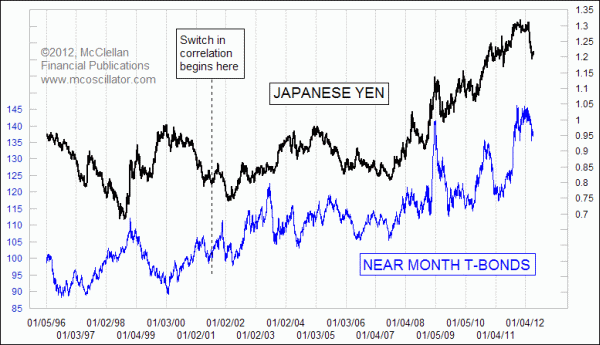
The whole reason why this is relevant for T-Bond prices is that there is a really strong positive correlation between T-Bond prices and the Japanese yen.  But this has not always been so.  The chart below shows that relationship, and you can see that before about mid-2001, it used to be an inverse relationship.  Somebody flipped a switch in 2001, and now it is a strong positive correlation.  

Japanese yen versus T-Bond prices

So because the yen does pretty much what T-Bond prices do, at least in terms of the direction of travel, we can make reasonable inferences about what lies ahead for bond prices by looking at what lies ahead for the yen.  When the commercial traders are holding their biggest net long position in Japanese yen futures in several years, the implication is pretty strong that the yen should head higher in the coming weeks.  And as the yen heads higher, T-Bonds ought to tag along, whether they deserve to go up or not.

Given what we have learned from another borrowed COT Report relationship, that positive period for T-Bonds is not likely to last beyond early June.  The inverse relationship between T-Bond price and stock prices is still working very well, so the opportunity for T-Bond prices to advance should only last as long as stocks are in a corrective mode, and that corrective mode is scheduled to be finished by early June. 


Article from Business Insider

Asia Stocks Slide as Europe Debt Crisis Concern Flares


By Yoshiaki Nohara - Apr 5, 2012 3:49 PM GMT+0800
Article from Bloomberg

Most Asian shares fell, with the regional benchmark index headed for its biggest two-day decline in a month, after Spain struggled to sell bonds, renewing concern Europe won’t be able to contain its debt crisis.

Hutchison Whampoa Ltd. (13) and other companies that do business in Europe slid after demand fell at a Spanish government bond auction, sparking concern about the region’s sovereign-debt crisis. Industrial & Commercial Bank of China Ltd. dropped 2 percent after Premier Wen Jiabao said China needs to break the “monopoly” of a few big lenders. Soho China Ltd. rose 2.5 percent, leading gains among mainland developers after Credit Agricole SA said China is “almost guaranteed” to ease monetary policy further this month.

The MSCI Asia Pacific Index dropped 0.1 percent to 125.33 as of 4:47 p.m. in Tokyo after losing as much as 1.2 percent. More than two shares fell for each that rose on the measure, which yesterday slid 1.5 percent, the most since Dec. 19, after the U.S. Federal Reserve signaled it may not offer more stimulus.

“Expectations for China’s additional easing are causing short-covering,” said Yutaka Miura, a senior technical analyst at Mizuho Securities Co. “It’s not that a real solution has been brought to Europe’s crisis. That’s why Spain’s debt sale is reviving concern.”

BOJ Nominee

The MSCI Asia Pacific Index has risen about 10 percent this year amid signs the U.S. economy is recovering. Gains slowed after China last month cut its target for economic growth as it seeks to cool the property market and become less dependent on exports.

Japan’s Nikkei 225 Stock Average pared a loss to 0.5 percent after the rejection of a Bank of Japan nominee came as a victory for lawmakers pressing for more monetary easing.

South Korea’s Kospi Index rose 0.5 percent after the government said foreign direct investment into the nation increased 17 percent in the first quarter. Australia’s S&P/ASX 200 fell 0.3 percent.

Hong Kong’s Hang Seng Index retreated 1.1 percent, with trading volume 6.9 percent below the 30-day average. Markets in the city were closed yesterday for a holiday and will also be shut tomorrow. India and the Philippines are having holidays today.

The Shanghai Composite Index, which tracks the bigger of China’s stock exchanges, rose 1.7 percent after the government said it will more than double the amount foreigners can invest in equities, bonds and bank deposits.

A measure of volatility on the Hang Seng index rose 7.9 percent to 19.99, indicating traders expect a swing of 5.7 percent on the gauge over the next 30 days. Readings for the Nikkei 225 and core stocks on South Korea’s benchmark dropped.

Spain Debt Sale

Futures on the Standard & Poor’s 500 Index (SPXL1) advanced 0.1 percent today. The gauge sank 1 percent in New York yesterday after a measure of conditions at U.S. service companies showed slowing growth.

In Europe, Spain struggled to borrow in financial markets yesterday, selling 2.6 billion euros ($3.4 billion) of bonds at an auction, an amount that was near the bottom of a range set by the Treasury for the sale. European Central Bank President Mario Draghi said the region’s economic outlook is “subject to downside risks.”

“Investors realize those economies are heading into a significant recession,” said Andrew Pease, Sydney-based chief investment strategist for the Asia-Pacific region at Russell Investment Group, which manages about $150 billion. “Gains from here are going to be hard work.”

Companies that do business in Europe slid. Hutchison Whampoa lost 1.9 percent to HK$76.20. Cosco Pacific Ltd. (1199), which operates container facilities at Greece’s Piraeus port, slid 1.9 percent to HK$11.36 in Hong Kong. Nissan Motor Co., a carmaker that gets almost a fifth of its revenue from Europe, lost 1 percent to 869 yen.

‘Almost Guaranteed’

Stocks in the Asian-Pacific index, which includes companies from emerging markets, are valued at 1.4 times book value, compared with 2.3 times for the S&P 500 and 1.4 times for the Stoxx 600, according to Bloomberg data. A number below 1 means companies can be bought for less than value of their assets.

Stocks pared losses amid speculation China may relax some of its measures aimed at damping inflation.

The country is “almost guaranteed” to either cut interest rates or reserve requirement ratios in April, Dariusz Kowalczyk, a Hong Kong-based strategist at Credit Agricole, said in a Bloomberg television interview yesterday. The strategist cited comments made by Premier Wen Jiabao on April 3 that he plans to release fine-tuning measures “soon.”

Easing Speculation

China also accelerated the opening of its capital markets by more than doubling the amount foreigners can invest in stocks, bonds and bank deposits. Offshore investors will also be allowed to pump an extra 50 billion yuan ($7.9 billion) of local currency into the country, up from 20 billion yuan, according to a statement on April 3.

Mainland developers gained in Hong Kong. Soho China rose 2.5 percent to HK$5.78, and China Overseas Land & Investment Ltd. advanced 0.9 percent to HK$15.98. Agile Property Holdings (3383) Ltd. rose 2 percent to HK$9.86.

In Seoul, NHN Corp., operator of South Korea’s largest Internet search engine, gained 8.1 percent to 274,000 won after Daewoo Securities Co. increased its share-price estimate to 340,000 won from 300,000 won, citing a stronger outlook for mobile-advertising sales and growing popularity of NHN’s messaging service.

To contact the reporter on this story: Yoshiaki Nohara in Tokyo at ynohara1@bloomberg.net
To contact the editor responsible for this story: Nick Gentle at ngentle2@bloomberg.net.

Article from Bloomberg

JPMorgan Tightens Grip on Bonds as Sales Surge: Credit Markets


By Matthew Leising - Apr 3, 2012 12:33 AM GMT+0800
Article from Bloomberg

JPMorgan Chase & Co. (JPM) is tightening its grip on the global corporate bond market, taking share from Citigroup Inc. (C) and Bank of America Corp. (BAC) and topping all underwriters as companies sold a record $1.17 trillion of debt.

The most profitable U.S. bank’s underwrote 7.1 percent of all bond sales in the three months ended March 31, up from 6.5 percent in 2011, data compiled by Bloomberg show. Citigroup moved up two spots to second with 5.7 percent, the same amount it captured last year. Bank of America dropped to third with 5.6 percent, down from 6.1 percent in 2011. Deutsche Bank AG (DBK), which dropped to fourth from third, handled 5.5, down from 5.9.

JPMorgan is leading banks reaping the benefits of a Federal Reserve outlook that benchmark interest rates will hold near zero until at least late 2014 and an easing in Europe’s debt crisis that has bolstered confidence that default rates will stay below the historical averages. Increased demand for higher- yielding assets is allowing companies from Australia to Amsterdam to borrow at record-low rates.

“A real positive outcome on Europe kicked the market into high gear,” said Richard Zogheb, co-head of capital markets origination for the Americas at Citigroup in New York. He cited European Central Bank’s unlimited three-year loans to the region’s lenders and a restructuring of Greece’s debt as reassuring bondholders. “Investor demand has been incredibly strong,” he said.

Record Sales

The average bond yield for companies from the neediest to the most creditworthy is 0.15 percentage point from the record low 3.99 percent reached in October 2010, according to Bank of America Merrill Lynch’s Global Broad Market Corporate & High Yield Index. Yields fell to 4.14 percent on March 30 from 4.17 percent a week earlier.

Corporate debt sales at a record start to the year are making underwriting one bright spot for Wall Street earnings. Mergers and acquisitions in the quarter fell about 14 percent from the fourth quarter, making it the slowest three-month period in 2 1/2 years, Bloomberg data show.

The largest U.S. banks will probably post a 10 percent decline in first-quarter fixed-income trading revenue from a year earlier and an 8 percent decline in equities trading, Keith Horowitz, a Citigroup bank analyst, said in a March 29 note.

Shrinking Spreads

Elsewhere in credit markets, benchmark gauges of corporate credit risk in the U.S. and Europe fell for a second day as manufacturing in the world’s biggest economy expanded at a faster pace in March. Hartford Financial Services Group Inc. (HIG), the insurer being pressured by investor John Paulson to break up, will pay about $2.43 billion to buy back debt and warrants issued to Allianz SE.

Bonds of oilfield-services company Weatherford International Ltd. were the most actively traded securities in the U.S. corporate market by dealers today, with 76 trades of $1 million or more as of 12:27 p.m. in New York, according to Trace, the bond-price reporting system of the Financial Industry Regulatory Authority.

The Geneva-based company sold $1.3 billion of debt on March 30, Bloomberg data show. Its $750 million of 4.5 percent notes due in April 2022 gained 1.8 cents to 101.626 cents on the dollar today from an issue price of 99.855, according to Trace.

The Markit CDX North America Investment Grade Index, which investors use to hedge against losses or to speculate on creditworthiness, fell 0.9 basis point to a mid-price of 90.5 basis points as of 12:26 p.m. in New York, according to Markit Group Ltd. In London, the Markit iTraxx Europe Index of 125 companies with investment-grade ratings declined 1.3 to 123.6, Markit prices show.

Hartford Issuing

The indexes typically fall as investor confidence improves and rise as it deteriorates. Credit-default swaps pay the buyer face value if a borrower fails to meet its obligations, less the value of the defaulted debt. A basis point equals $1,000 annually on a swap protecting $10 million of debt.

Hartford Financial plans to issue senior notes and junior subordinated debt as part of a strategy to improve financial flexibility, according to a statement today from the company, which is based in the Connecticut city of the same name. The U.S. firm turned to Allianz, Germany’s largest insurer, for capital in 2008, agreeing to pay 10 percent on $1.75 billion of debt as capital markets froze.

Hartford plans to sell 5.5-, 10-, and 30-year debt that may price today, according to a person familiar with the offering, who declined to be identified because terms aren’t set.

Corporate Bond Sales

In the corporate bond market, investors are scooping up the new debt as companies hold the most cash on their balance sheets in a decade. Cash held by companies in a JPMorgan investment- grade bond index increased 5 percent to $783 billion at the end of December from a year earlier, strategists at the bank said in a March 2 report.

“The fundamentals and the balance sheets look historically very strong,” said Brian Machan, a money manager with Aviva Investors North America in Des Moines, Iowa, who helps oversee $433 billion. “From an economic standpoint we’re still middling along, so corporations don’t want to leverage their balance sheet until we see recurring signs of economic recovery.”

Issuers rated Baa3 or higher by Moody’s and BBB- and above by S&P sold $347.5 billion U.S. dollar-denominated bonds in the quarter, the highest for investment-grade debt since the same period in 2009, when $376.3 billion was issued, Bloomberg data show.

High-Yield Bonds

Speculative-grade borrowers in the U.S. issued $95.2 billion of debt in the quarter, surpassing the $61.2 billion of combined issuance in the third and fourth quarters last year, Bloomberg data show.

Investors seeking the higher-yielding debt are emboldened by a global default rate for the riskiest borrowers that was 2 percent in February, compared with a long-term average 4.8 percent, according to Moody’s.
The quality of corporate borrowers is better than in past periods of large high-yield issuance, said Andy O’Brien, global co-head of debt capital markets at JPMorgan. Issuers with one or more rating of BB or higher made up 41 percent of the market last quarter, compared with about 25 percent in 2007, he said.
LyondellBasell Industries NV (LYB), the chemical maker that emerged from bankruptcy in 2010, lowered its rates on $3 billion of debt sold in two issues last month to 5 percent and 5.75 percent, compared with 8 percent and 11 percent for debt it’s seeking to repurchase with proceeds from the new bonds.

Citigroup Rebound

Investors last quarter shifted money out of low-risk, low- return assets such as money market funds and put some of that cash into credit markets, O’Brien said. According to JPMorgan global bond indexes, that caused yields on the debt of the highest-rated companies in the quarter to fall below 4 percent for the first time, he said.

“A lot of corporate issuers across the ratings spectrum rushed to the market to issue,” he said. “Several BB companies were even able to issue 5 percent money.”

Citigroup, which led global underwriting from 2007 to 1999, when Bloomberg began tracking the data, moved to second in the quarter in part because of new hires made in 2010 and 2011 to expand the business, Zogheb said. Those bankers include Stephen Trauber, the global head of energy investment banking, and Kevin Cox, the co-chairman of global industrials investment banking, he said. Citigroup hired both from UBS AG.

“Our investment in shoring up the banking ranks and filling some holes we had are really paying dividends,” Zogheb said. “There continues to be very strong demand for corporate debt products across all markets.”
One absent driver in the debt market during the quarter were mergers and acquisitions and leveraged buyouts, said Marc Gross, a fund manager at RS Investments, who oversees $3 billion in high-yield and loan funds in New York. With few bonds maturing in the next two years “to keep up this activity you’re going to need M&A,” he said.

With the improved credit markets, that’s likely to pick up, JPMorgan’s O’Brien said. “M&A activity is bound to pick up this quarter,” he said.

To contact the reporter on this story: Matthew Leising in New York at mleising@bloomberg.net
To contact the editor responsible for this story: Alan Goldstein at agoldstein5@bloomberg.net

Article from Bloomberg