Bonds Investment TV

A year since 'taper tantrum,' bond market calm confounds investors

By Michael Santoli
Article from http://finance.yahoo.com/blogs
Posted on Fri, May 9, 2014, 8:32pm EDT 

A year since the dramatic “taper tantrum,” the bond market is again confounding skeptical investors — but this time with its persistent composure and calm. 

In May of last year, Federal Reserve Chairman Ben Bernanke touched off a mini-panic in the Treasury market by describing his intention to gradually reduce the Fed’s pace of bond buying in response to firming economic conditions. In the harried anticipation of the “tapering” of the Fed’s quantitative-easing program, bond yields rushed higher, from below 1.7% early that month to 2.16% by May 31. 

The benchmark yield reached 2.98% around Labor Day — a wild and painful velocity of selling for the world’s most liquid market. The 10-year ultimately peaked at 3.02% on Dec. 31, and since has eased back toward 2.60%. 

From a wider view, the yield has spent more than 10 months lolling between 2.50% and 3%, upending popular expectations that yields would climb steadily higher and make bond investments treacherous. The consensus based this view on expectations of waning Fed support, a broad pickup in the world economy and a flow of investor dollars from bonds toward stocks. Of these firmly held premises, only the Fed’s well-telegraphed monthly reduction in bond-purchase volume has decisively come to pass. 

A 'flummoxed' market

“The market is flummoxed,” says William O’Donnell, co-head of markets strategy at RBS Securities. Hedge funds continue to bet on higher rates by shorting Treasury futures, and fund-manager surveys continue to show dislike for bonds.

And yet a variety of powerful forces have kept real money flowing into bonds, and their persistence will likely act as a shorter chain anchoring yields at lower levels than accompanied past economic cycles. 

Among the factors: 

The strong rebound in equity markets got pension funds fully funded and topped up their allocation to stocks, leaving them hungry to lock in long-term yields to fund future obligations and stoking a strong appetite for longer-term debt. Insurance companies and foreign central banks have followed this path, too. And U.S. banks have also become aggressive buyers of Treasuries as they seek safe “carry,” or interest-rate spread, income. 

In short, there hasn’t been much of a “great rotation” of cash from bonds into stocks, in large part because strong stock-market performance itself did investors’ rotating for them. 

The persistent demand for yield is meeting a relatively constrained supply of “interest rate” available in the world. In some respects, as reported here in February, there is a “bond shortage.”

Meantime, stimulative Japanese central bank bond buying and the widespread belief that the European Central Bank is committed to backstopping sovereign debt markets on the Continent have compressed foreign government yields to levels below what almost anyone expected. 

With German 10-year yields below 1.5% and those of Italy, Spain and Ireland beneath 3%, U.S. Treasuries just above 2.50% look like a downright cheap source of safe income by comparison. 

Investors are coming around to Fed Chair Janet Yellen’s message that, after the Fed sunsets its QE program – perhaps by October, possibly later – it will still be a relatively long time before short-term interest rates are lifted. The important point of Yellen’s recent line of communication is that short-term interest rates will ultimately peak at far lower levels than in past “normal” economic cycles. 

Michael Darda, strategist at MKM Partners, now forecasts short-term rates will be lifted only to 2% to 3% at this business-cycle peak, some years down the road, compared to 4% or higher in pasty tightening phases. In this respect, this cycle resembles those immediately after World War II, when long-term rates were rather steady at low levels for years on end. In the late ‘40s and ‘50s, benchmark Treasury yields peaked between 2.4% and 3.9%. 

The U.S. economy’s perceived chances of surging toward “escape velocity” have diminished in recent months. The first quarter’s leaden 0.1% early reading on GDP means the math for getting to 3% for the full year has become challenging. This dampens fears that inflation pressures will build as economic slack is reduced quickly, and makes investors more comfortable owning bonds. 

All this goes a long way toward explaining why rates have been suppressed, and why, in turn, corporate bonds and all other debt products have been enjoying huge demand. It doesn’t mean bonds are a great buy at these levels, or that rates won’t drift higher. But a surge in rates seems less likely than the conventional wisdom continues to hold. 

O’Donnell believes 10-year Treasury yields will stay roughly in their recent range, meaning traders can lighten up on bonds near the current lower end of the range and look to buy as yields get closer to 3%. He thinks a likely, though fleeting, catch-up move in the Fed’s preferred inflation measure – personal consumption expenditures – this month could jar yields a bit higher. But he would view that as a chance for tactical investors to add a bit more exposure to Treasuries, which have so far refused to comply with those popular calls to throw another tantrum.


Michael Santoli
Article from http://finance.yahoo.com/blogs
Posted on Fri, May 9, 2014, 8:32pm EDT 

Wall Street Week Ahead-Bond, stock investors making hay; can both be right?

By Rodrigo Campos
NEW YORK Fri May 2, 2014 6:27pm EDT
Article from http://www.reuters.com/article/

(Reuters) - With U.S. stocks near record highs and Treasury bond yields near multi-month lows, the disconnect between equity and debt investors has rarely been as stark. Over the coming months, the economy is likely to show one of the groups has bet wrong.

The S&P 500 .SPX sits less than one percent below an all-time high. After a wintry first quarter, stock investors are betting that economic growth is picking up, as evidenced by stronger spending figures and business demand. That's boosted the cyclical stocks which react to rising demand, particularly energy shares.

"The data are suggesting this may be the year when we turn the corner," said Quincy Krosby, market strategist at Prudential Financial in Newark, New Jersey.

"If data continues to gain traction you're going to see investors turn to more cyclical parts of the market. And I think that's already started."

Bond investors are reacting to a different story. Yields on the 10-year note hit a five-month low on Friday and the 30-year note's yield fell to its lowest since June after the April jobs report, which showed strong growth in payrolls but no growth in earnings and a decline in the labor force.

That data points to the conclusion that overall economic demand will remain tepid and that inflation won't materialize as the Federal Reserve continues to pull back on monetary stimulus, analysts said.

"Fixed income investors are slowly waking up to the reality that as the Fed steps back from quantitative easing, there are no signs of inflation," wrote Andrew Wilkinson, chief market analyst at Interactive Brokers in Greenwich, Connecticut, in a note.

Bonds are also gaining as concern about the Ukraine-Russia crisis heightens the safe-haven appeal of U.S. debt, while some corporate pension funds are increasingly shifting to bonds as they seek to match their holdings to the liabilities they are going to face.

Still, the rise in equity markets doesn't mean that investors are as confident about growth stocks as they were in 2013. The strongest sector in 2014 is utilities, which have gained 14 percent and are generally associated with safety. Consumer discretionary shares such as Amazon.com are down 4.2 percent, the worst-performing sector so far this year.

This may be changing. Data show that the latest internal rotation in stocks has seen the energy sector take the lead, with a 4.2 percent gain over the last month.

Capacity utilization, a measure of how much industrial power is being put to work, rose last month to its highest in nearly six years and is expected to have ticked higher in the April report, while Fed data showed last week that commercial and industrial loans grew at a steady pace in April.

This makes it entirely possible that the bond market - generally the more sober-minded of the two markets - may have it wrong.

"We believe that the current pricing in the Treasury market has insufficiently accounted for the potential for an explosion in GDP growth," said Millan Mulraine, deputy head of U.S. research and strategy at TD Securities USA in New York in a research note.

(Reporting by Rodrigo Campos; additional reporting by Jennifer Ablan and Jonathan Spicer. Editing by David Gaffen and John Pickering)

Rodrigo Campos
NEW YORK Fri May 2, 2014 6:27pm EDT
Article from http://www.reuters.com/article/

Wall Street Bond Dealers Whipsawed on Bearish Treasuries Bet

By Lisa Abramowicz and Daniel Kruger Apr 22, 2014 12:01 AM GMT+0800
From http://www.bloomberg.com/news/

Betting against U.S. government debt this year is turning out to be a fool’s errand. Just ask Wall Street’s biggest bond dealers.

While the losses that their economists predicted have yet to materialize, JPMorgan Chase & Co. (JPM), Citigroup Inc. (C) and the 20 other firms that trade with the Federal Reserve began wagering on a Treasuries selloff last month for the first time since 2011. The strategy was upended as Fed Chair Janet Yellen signaled she wasn’t in a rush to lift interest rates, two weeks after suggesting the opposite at the bank’s March 19 meeting.

The surprising resilience of Treasuries has investors re-calibrating forecasts for higher borrowing costs as lackluster job growth and emerging-market turmoil push yields toward 2014 lows. That’s also made the business of trading bonds, once more predictable for dealers when the Fed was buying trillions of dollars of debt to spur the economy, less profitable as new rules limit the risks they can take with their own money.

“You have an uncertain Fed, an uncertain direction of the economy and you’ve got rates moving,” Mark MacQueen, a partner at Sage Advisory Services Ltd., which oversees $10 billion, said by telephone from Austin, Texas. In the past, “calling the direction of the market and what you should be doing in it was a lot easier than it is today, particularly for the dealers.”

On March 31, Federal Reserve Chair Janet Yellen highlighted inconsistencies in job data... Read More

Treasuries (USGG10YR) have confounded economists who predicted 10-year yields would approach 3.4 percent by year-end as a strengthening economy prompts the Fed to pare its unprecedented bond buying.

Caught Short

After surging to a 29-month high of 3.05 percent at the start of the year, yields on the 10-year note have since declined and were at 2.7 percent at 11:55 a.m. in New York.

One reason yields have fallen is the U.S. labor market, which has yet to show consistent improvement.

The world’s largest economy added fewer jobs on average in the first three months of the year than in the same period in the prior two years, data compiled by Bloomberg show. At the same time, a slowdown in China and tensions between Russia and Ukraine boosted demand for the safest assets.

Wall Street firms known as primary dealers are getting caught short betting against Treasuries.

They collectively amassed $5.2 billion of wagers in March that would profit if Treasuries fell, the first time they had net short positions on government debt since September 2011, data compiled by the Fed show.

‘Some Time’

The practice is allowed under the Volcker Rule that limits the types of trades that banks can make with their own money. The wagers may include market-making, which is the business of using the firm’s capital to buy and sell securities with customers while profiting on the spread and movement in prices.

While the bets initially paid off after Yellen said on March 19 that the Fed may lift its benchmark rate six months after it stops buying bonds, Treasuries have since rallied as her subsequent comments strengthened the view that policy makers will keep borrowing costs low to support growth.

On March 31, Yellen highlighted inconsistencies in job data and said “considerable slack” in labor markets showed the Fed’s accommodative policies will be needed for “some time.”

Then, in her first major speech on her policy framework as Fed chair on April 16, Yellen said it will take at least two years for the U.S. economy to meet the Fed’s goals, which determine how quickly the central bank raises rates.

After declining as much as 0.6 percent following Yellen’s March 19 comments, Treasuries have recouped all their losses, index data compiled by Bank of America Merrill Lynch show.
Yield Forecasts

“We had that big selloff and the dealers got short then, and then we turned around and the Fed says, ‘Whoa, whoa, whoa: it’s lower for longer again,’” MacQueen said in an April 15 telephone interview. “The dealers are really worried here. You get really punished if you take a lot of risk.”

Economists and strategists around Wall Street are still anticipating that Treasuries will underperform as yields increase, data compiled by Bloomberg show.

While they’ve ratcheted down their forecasts this year, they predict 10-year yields will increase to 3.36 percent by the end of December. That’s more than 0.6 percentage point higher than where yields are today.

“My forecast is 4 percent,” said Joseph LaVorgna, chief U.S. economist at Deutsche Bank AG, a primary dealer. “It may seem like it’s really aggressive but it’s really not.”

LaVorgna, who has the highest estimate among the 66 responses in a Bloomberg survey, said stronger economic data will likely cause investors to sell Treasuries as they anticipate a rate increase from the Fed.

History Lesson

The U.S. economy will expand 2.7 percent this year from 1.9 percent in 2013, estimates compiled by Bloomberg show. Growth will accelerate 3 percent next year, which would be the fastest in a decade, based on those forecasts.

Dealers used to rely on Treasuries to act as a hedge against their holdings of other types of debt, such as corporate bonds and mortgages. That changed after the credit crisis caused the failure of Lehman Brothers Holdings Inc. in 2008.

They slashed corporate-debt inventories by 76 percent from the 2007 peak through last March as they sought to comply with higher capital requirements from the Basel Committee on Banking Supervision and stockpiled Treasuries instead.

“Being a dealer has changed over the years, and not least because you also have new balance-sheet constraints that you didn’t have before,” Ira Jersey, an interest-rate strategist at primary dealer Credit Suisse Group AG (CSGN), said in a telephone interview on April 14.

Almost Guaranteed

While the Fed’s decision to inundate the U.S. economy with more than $3 trillion of cheap money since 2008 by buying Treasuries and mortgaged-backed bonds bolstered profits as all fixed-income assets rallied, yields are now so low that banks are struggling to make money trading government bonds.

Yields on 10-year notes have remained below 3 percent since January, data compiled by Bloomberg show. In two decades before the credit crisis, average yields topped 6 percent.

Average daily trading has also dropped to $551.3 billion in March from an average $570.2 billion in 2007, even as the outstanding amount of Treasuries has more than doubled since the financial crisis, according data from the Securities Industry and Financial Markets Association.

“During the crisis, the Fed went to great pains to save primary dealers,” Christopher Whalen, banker and author of “Inflated: How Money and Debt Built the American Dream,” said in a telephone interview. “Now, because of quantitative easing and other dynamics in the market, it’s not just treacherous, it’s almost a guaranteed loss.”

Trading Revenue

The biggest dealers are seeing their earnings suffer. In the first quarter, five of the six biggest Wall Street firms reported declines in fixed-income trading revenue.

New York-based JPMorgan, the biggest U.S. bond underwriter, had a 21 percent decrease from its fixed-income trading business, more than estimates from Moshe Orenbuch, an analyst at Credit Suisse, and Matt Burnell of Wells Fargo & Co.

Citigroup, whose bond-trading results marred the New York-based bank’s two prior quarterly earnings, reported a 18 percent decrease in revenue from that business. Credit Suisse, the second-largest Swiss bank, had a 25 percent drop as income from rates and emerging-markets businesses fell. Declines in debt-trading last year prompted the Zurich-based firm to cut more than 100 fixed-income jobs in London and New York.

Chief Financial Officer David Mathers said in a Feb. 6 conference call that Credit Suisse has “reduced the capital in this business materially and we’re obviously increasing our electronic trading operations in this area.”

Bank Squeeze

Jamie Dimon, chief executive officer at JPMorgan, also emphasized the decreased role of humans in the rates-trading business on an April 11 call as the bank seeks to cut costs.

About 49 percent of U.S. government-debt trading was executed electronically last year, from 31 percent in 2012, a Greenwich Associates survey of institutional money managers showed. That may ultimately lead banks to combine their rates businesses or scale back their roles as primary dealers as firms get squeezed, said Krishna Memani, the New York-based chief investment officer of OppenheimerFunds Inc., which oversees $79.1 billion in fixed-income assets.

“If capital requirements were not as onerous as they are now, maybe they could have found a way of making it work, but they aren’t as such,” he said in a telephone interview.

To contact the reporters on this story: Lisa Abramowicz in New York at labramowicz@bloomberg.net; Daniel Kruger in New York at dkruger1@bloomberg.net

To contact the editors responsible for this story: Dave Liedtka at dliedtka@bloomberg.net Michael Tsang


Lisa Abramowicz and Daniel Kruger Apr 22, 2014 12:01 AM GMT+0800
From http://www.bloomberg.com/news/

Stocks and bonds under Fed pressure

By Hibah Yousuf @CNNMoneyInvest May 13, 2013: 4:51 PM ET
Article from http://money.cnn.com/

NEW YORK (CNNMoney)

The jokes about QE Infinity may come to an end soon.

The Federal Reserve and its bond buying program were a hot topic Monday, following a Wall Street Journal report over the weekend that said central bank officials are considering an exit strategy for the massive stimulus measures that have been fueling the economy since late 2008. Stocks finished mixed Monday.

Currently, the Fed buys $85 billion a month of mortgage-backed securities and Treasuries. And just last month, the central bank said it stands ready to either "increase or reduce the pace" of those purchases in response to economic activity.

"The article does not say that the Fed will start tapering the pace of bond purchases immediately, but it provides a window into sentiment at the central bank," said Zach Pandl, senior interest rate strategist at Columbia Management. "Faced with conflicting information on the economy, Fed officials have decided to see the glass as half full. They are thinking about the exit, not about how to do more."

The fear that the Fed may begin to unwind its loose monetary policies sooner rather than later put pressure on U.S. Treasuries, with the 10-year yield spiking to a nearly two-month high of almost 1.96% before settling around 1.92%. Just a month ago, yields were hovering around 1.6%. Treasury prices and yields move in opposite directions.


Meanwhile, the Dow Jones industrial average slipped about 0.2%, while the S&P 500 and Nasdaq finished barely higher. But the gain in the S&P 500 was enough to push it to another record close.

The Fed's policies have been widely given credit for boosting stocks over the past few years.

As investors debate the Fed's next moves, here are five more things investors were watching:

1. Stocks remain near record highs as valuations creep up. Although the Dow fell Monday, it finished last week at a record high. The Nasdaq closed at its highest level since November 2000.

With stocks up so sharply this year, valuations have also crept higher. At its closing high last week, the S&P 500 traded at more than 16 times 2012 earnings, the highest P/E ratio in three years according to Eddy Elfenbein of the blog Crossing Wall Street.

However, stocks are still trading at less than 15 times 2013 earnings estimates.

2. Retail sales unexpectedly rise: Retail sales edged higher in April, as strong car sales and spending on building supplies helped make up for weakness in other sectors. Economists had expected sales to decline.

Mark Luschini, chief investment strategist for Janney Montgomery Scott, said retail spending "continues to show remarkable resilience," especially after the expiration of the payroll tax holiday earlier this year.

3. Earnings continue to roll in: Companies will continue to open their books this week, with Macy's (M, Fortune 500), Wal-Mart (WMT, Fortune 500) and J.C. Penney (JCP, Fortune 500), as well as networking firm Cisco Systems (CSCO, Fortune 500) on deck.

Shares of Tesla Motor (TSLA)extended last week's rally. The electric car maker reported its first quarterly profit last week, and a separate report said Tesla sales outperformed German luxury brands.

SolarCity (SCTY), whose chairman is Tesla CEO Elon Musk, reported a quarterly loss after the closing bell Monday. Shares fell after hours but they had surged to an all-time high in regular trading Monday. Shares of other solar firms were energized by SolarCity's advance earlier in the day. Shares of First Solar (FSLR), SunPower Corp. (SPWR), LDK Solar (LDK) and ReneSola (SOL) also rose.

Most major companies have announced their first-quarter earnings and results have been pretty good. According to S&P Capital IQ, of the 453 S&P 500 companies that have reported first quarter results, 301 have beat analysts' estimates, 115 have missed, and 37 have met.

4. Disappointing data from China: Asian markets ended mixed after a report showed China's industrial production expanded in April, but failed to meet expectations. The Shanghai Composite declined 0.2% and the Hang Seng dropped 1.5%.

But the weakening yen pushed the Nikkei up 1.2%. Tokyo's benchmark index has rallied by 42% since the start of the year based on optimism about the country's aggressive monetary policy.

5. Muddy Waters reportedly shorting Standard Chartered: Standard Chartered (SCBFF) fell into the spotlight after famed short-seller Carson Block of Muddy Waters Research was reported to have announced he is betting against the bank, saying its assets were deteriorating.

European markets finished the day mixed, losing momentum after a strong performance last week.  


First Published: May 13, 2013: 10:13 AM ET
Hibah Yousuf @CNNMoneyInvest May 13, 2013: 4:51 PM ET
Article from http://money.cnn.com/

BOJ may seek ways to calm bond yields, policy on hold


By Leika Kihara
TOKYO | Thu May 16, 2013 11:29pm EDT
Article from http://www.reuters.com/article/


(Reuters) - The Bank of Japan is expected to stand pat on monetary policy next week despite jitters over the recent jump in bond yields, hoping it can stem the volatility by fine-tuning market operations.

The central bank may front-load bond purchases or offer funds via market operations more frequently if the bond market turbulence persists, which are technical steps that can be taken by its bureaucrats without approval by the nine-member board.

It is expected to hold off on easing policy through further increases in asset purchases, having already pledged in April to double its bond holdings in two years to expand the supply of money at an annual pace of 60 trillion ($588 billion) to 70 trillion yen.

The recent bond selloff, which sent the 10-year yield to a one-year high of 0.92 percent on Wednesday, has highlighted the dilemma the central bank faces as it attempts to generate inflation in a country mired in price falls for 15 years.

"The BOJ is walking a very narrow path trying to engineer a gradual, not a sudden, rise in long-term rates backed by improvements in the economy," said an official with knowledge of the central bank's thinking.

The BOJ unleashed the world's most intense burst of stimulus last month, promising to inject $1.4 trillion into the economy in less than two years to meet its pledge of achieving 2 percent inflation in roughly two years.

By gobbling up 70 percent of the bonds newly issued by the government, it hopes to nudge Japanese investors out of the safety of bonds and into riskier assets like equities.

The rise in Tokyo shares to a 5-1/2-year high shows this may be starting to happen.

BOJ officials say they would accept a natural rise in long-term interest rates that reflect prospects of an economic recovery and future inflation.

But the intensity of the BOJ's purchases caused disruptions in the market by drying up liquidity, making bond prices vulnerable to sharp swings that could potentially lead to a damaging sell-off hard to control.

The pace of bond price falls and the huge volatility has made some central bankers nervous, but not enough to consider additional policy steps at the two-day policy meeting that ends on Wednesday next week.

LACK OF SOLUTIONS

Japan's economy expanded at an annualized 3.5 percent in the first quarter, the fastest in a year, offering evidence that Prime Minister Shinzo Abe's sweeping stimulus is beginning to work.

The BOJ may thus revise up its assessment of the economy to say it is picking up, compared with the previous month's view that it is "bottoming out with some signs of a pick-up."

But a sustained sharp rise in bond yields will hurt corporate capital expenditure, the soft spot of an otherwise more robust economy, and strain Japan's already tattered finances by boosting the cost of funding its huge debt pile.

Finance Minister Taro Aso appeared sanguine so far, telling parliament on Friday that it made sense for investors to shift funds out of bonds and into equities given recent sharp rises in Tokyo stock prices.

For now, the central bank hopes to use market operations to stem the volatility. It did so on Wednesday by offering to inject 2.8 trillion yen into the Tokyo money market, more than three times the size usually offered in a single day.

If volatility persists, the BOJ may also consider increasing the amount of bonds it buys each month from the current 7.5 trillion yen until bond prices stabilize, sources say.

But there is no guarantee that such minor tweaks in its bond-buying program can soothe market jitters for long. Wednesday's huge fund injection failed to prevent bond yields from ending higher for a fourth session.

Expanding stimulus, by pledging to increase bond purchases even more, could backfire by draining already thin liquidity in the market.

"The bond market has been distorted by the BOJ. It's reliant on central bank purchases more than ever, and a lack of liquidity will keep it vulnerable to sharp swings," said Masaaki Kano, chief Japan economist at JPMorgan Securities.

"The BOJ probably didn't expect so much volatility, and simply boosting its bond purchases won't solve the problem."

($1 = 101.9600 Japanese yen)

(Editing by Kim Coghill)

JAPAN


Leika Kihara
TOKYO | Thu May 16, 2013 11:29pm EDT
Article from http://www.reuters.com/article/

Australia to Sell 2025 Bond Next Week, Slow Sales Pace in ’13-14

By Garfield Reynolds - May 15, 2013 9:22 AM GMT+0800
Article from http://www.bloomberg.com/news/


Australia will sell a new 2025 bond next week and slow the pace of gross debt offerings in the fiscal year starting July 1 as the government seeks to rein in budget deficits.

Notes maturing April 21, 2025, will be offered through syndication, the Australian Office of Financial Management said today in an e-mailed statement. The funding arm said it expects to sell about A$50 billion ($49.5 billion) in the coming fiscal year. That compares with the A$53.6 billion of sales indicated for the 12 months ending June 30 in the federal budget presented by Treasurer Wayne Swan in Canberra yesterday.

The amount of outstanding government bonds maturing in a year or more will rise to A$260 billion by June 30, 2014, from an estimated A$233 billion a year earlier, the budget shows.


May 15 (Bloomberg) -- Australian Shadow Finance Minister Andrew Robb talks about the budget announced yesterday and the outlook for the country's economy. The government will spend A$24 billion ($23.8 billion) on road and rail projects, while targeting A$43 billion of savings over five years in an effort to return to surplus by 2016-17, Treasurer Wayne Swan said in budget papers released yesterday. Robb speaks from Canberra with Susan Li on Bloomberg Television's "First Up."

Julia Gillard, Australia’s first female prime minister, trails in opinion polls with an election due Sept. 14, after a blown pledge to return the budget to surplus and mining taxes that failed to reap promised revenue. Swan forecast the deficit will be A$19.4 billion this fiscal year, after projecting a surplus in October forecasts, as revenue dropped A$16.6 billion from previous estimates. The budget shortfall is projected to shrink to A$18 billion in the 12 months ending June 30, 2014.

Next week’s sale of a new bond line will be managed by Citigroup Inc., Deutsche Bank AG, UBS AG and Westpac Banking Corp., the AOFM said in its statement. The funding arm expects to sell A$700 million of bonds on most Wednesdays and Fridays from the week starting May 27 until the end of the financial year, it said.
Linker Sales

The AOFM will offer A$150 million to A$250 million of 2022 indexed notes this month and a similar amount of 2025 inflation-linked debt in June. The government will double sales of linkers to A$4 billion in the coming fiscal year, increasing the amount of such notes to A$22 billion.

That will swell the nation’s outstanding securities to at least A$282 billion by June 30, 2014, 6 percent shy of the A$300 billion legal borrowing limit. Swan raised the limit on borrowings this fiscal year from A$250 billion.

Australia’s sovereign debt market has more than quadrupled since the end of 2008 as the government borrowed to fund stimulus programs during the global financial crisis.
Yields Declined

Over that time, the nation’s benchmark 10-year bond yield dropped to 3.30 percent as of 11:18 a.m. in Sydney from 3.99 percent on Dec. 31, 2008. It climbed to as high as 5.88 percent in April 2010 and reached a record low 2.698 percent on June 4, 2012. The premium over similar-maturity U.S. notes was at 133 basis points, down 19 basis points this year.

Average yields at bond auctions fell to 3.23 percent in 2012, the lowest annual average in Australian Office of Financial Management data going back to 1982. The average this year is 3.29 percent, after the AOFM sold A$600 million of notes maturing in 2027 at an average yield of 3.6289 percent at auction today.

Net debt will peak at A$191.6 billion in 2014-15, or 11.4 percent of gross domestic product, up from A$161.6 billion, or 10.6 percent, in the current fiscal year, according to the budget. U.S. net debt is expected to peak next year at 89.7 percent of GDP, when the average for advanced nations will be 79.1 percent, the International Monetary Fund said last month.

To contact the reporter on this story: Garfield Reynolds in Sydney at greynolds1@bloomberg.net

To contact the editor responsible for this story: Rocky Swift at rswift5@bloomberg.net


Garfield Reynolds - May 15, 2013 9:22 AM GMT+0800
Article from http://www.bloomberg.com/news/

Rethink your bond strategy for retirement

Robert Powell's Retirement Portfolio
Article from http://www.marketwatch.com/story/

May 11, 2013, 7:01 a.m. EDT


Time to re-evaluate definition of fixed income

The pundits would have us believe that the bull market in bonds is over. That bond prices have nowhere to go but down and yields up.

Case in point: Berkshire Hathaway BRK.A +1.01%   BRK.B +1.05%  Chairman and Chief Executive Warren Buffett told CNBC this week that bonds are “a terrible investment” right now. And Loomis Sayles’ Dan Fuss earlier this year said the fixed-income market is more “overbought” than at any time in his 55-year career.

Overbought and terrible investments as bonds might be, the market doesn’t seem as convinced. Consider, for instance, the yields on Treasury Inflation Protected Securities, also known as TIPS. Those that mature in five years yield -1.28% while those that mature in 10 years yield -0.48%. See Daily Treasury Real Yield Curve Rates.

In other words, bonds might not be the best investment, but the looming bond losses predicted by Fuss, Buffett and others might be a long way off. If that’s the case, what should those planning for or living in retirement do with the money they’ve allocated to fixed-income securities?

And, what if Buffett, Fuss, and others are right in their assessment, that bonds are a terrible investment? What then? Buy, sell, hold or hide your head in the sand? What’s a retiree or retirement saver to do?

In the main, advisers we interviewed agreed with Buffett and Fuss. They say the great bull market in bonds is over, though it might be a while before the bear market begins. Call it a holding pattern with the best bet being avoid or sell long-term bonds.

For instance, William Suplee IV, president of Structured Asset Management, says there are few reasons to own long-term bonds, or TIPS for that matter. “Bonds have run the full cycle from 1950 to 1982 and back till today,” said Suplee. “There is almost nothing left in the long end with one big exception.”

And that exception is this: Should there be a Japanese-style long-term deflationary spiral then long bonds are still a good investment. “But that’s only under that type of scenario and it doesn’t look that probable,” Suplee said.

As for TIPS, Suplee said those investments are “fully priced” and the only reason to hold them now is as an inflation hedge. “If we have big inflation they will help, but not as much as you would wish because of the pricing,” he said. “The real yield will be below inflation.”

Another manger is of the same opinion. “We wouldn’t touch TIPS at these prices,” said Christopher Pavese, the chief investment officer at Broyhill Asset Management.

In the event of hyperinflation, however, Suplee said TIPS will be like gold as a store of purchasing power except for the fact that they have poor tax consequences. “TIPS are taxable and don’t throw off cash flow,” he said. “Ouch?”

(TIPS, for those for whom such instruments are a prudent investment, are best owned in qualified accounts, he said.)

But no matter whether you own TIPS in a taxable or tax-deferred account, Suplee said, the day is dawning when it will be time to get out of them. “Keep durations short,” he said, noting that TIPS, though there’s no associated cash flows, do have an inflation adjustment and tend to have longer durations in some circumstances.

Others agree that it’s time to avoid or dump long bonds. “If the bull market in bonds isn’t over, then you have to ask yourself if you feel lucky, or if you want to become a trader, because the risk level is too high to justify a ‘buy-and-hold’ approach,” said Michael Falk, a partner with Focus Consulting Group and chief strategist at Mauka Capital.

To the extent you cannot spend less in retirement, retire later or work some, his advice to retirees and would-be retirees would be to shorten the maturities of the bonds or bond funds in your portfolio. Consider also adding to the mix a type of annuity that provides a monthly income when you’re age 80+. “The annuity would help to protect against outliving your slower-growth/less-income producing portfolio,” Falk said.

 Bonds still have a role in your portfolio

No matter whether the bull market in bonds is over or not, others insist that fixed-income securities still have role to play in your portfolio. “Interest rates have declined substantially over the past 30 years, and at today’s low levels, investors need to accept that the great returns they have generated in the past will not be earned in the future,” said John Nersesian, a managing director of wealth management services at Nuveen Investments. “However, we believe bonds still play an important role in building a diversified portfolio for most investors. An allocation to bonds, by definition, is money that is not allocated to stocks.”

What’s more, Nersesian said bonds tend to do well during periods of equity weakness. So, an allocation to this asset class offers a significant benefit—that being a reduction in volatility. And reducing volatility is important for two reasons. “One, volatility during retirement forces the investor to liquidate more assets at depressed prices which increases the risk of failure,” Nersesian said. “Additionally, volatility causes emotional stress for the investor which can often lead to poor decision making.”

Remember, he said, it’s not the average rate of return that determines investor success. “It’s how the return is achieved (sequence, volatility, and the like),” he said.

The days of simply investing 60% in stocks and 40% in plain-vanilla bonds, however, may no longer be sufficient for investors. “Investors need to think creatively in today’s interest-rate world,” said Nersesian. “Diversifying your sources of income can provide some advantages.”

Nersesian noted, for instance, that there are some interesting opportunities in high yield, foreign debt, preferred securities and municipal issues that allow investors to participate in fixed-income markets.

Others are taking a similar tack. Pavese, for instance, said that most of his firm’s fixed-income exposure is concentrated in more nontraditional segments of the market, such as mortgages. “These securities have had a tremendous run since forced selling punished prices in 2011, and the trade is in later innings today, but historically, late innings have seen the biggest gains in asset prices,” Pavese said. “Particularly, as we see more institutional money flowing into this segment of the bond market. Rising demand plus shrinking supply equals higher prices.”

Time to re-evaluate definition of fixed income

Pavese also suggested that investors should re-evaluate their definition of ‘fixed’ income. “Bonds still play an important role in portfolios from a risk-reduction standpoint,” he said, agreeing with Nersesian. “We even bought some long-term Treasurys recently, to hedge equity risk, as 10-year yields backed up over 2%,” he said. “But ‘fixed’ income will present a big risk to retirement planning once the impact of global money printing shows up in higher inflation down the road. Consequently, high quality businesses that generate and distribute rising cash earnings to investors should play an increasingly important role in portfolios.”

See “Investing for Income” in this week’s Retirement Weekly subscription newsletter to read which companies, according to Pavese, could play an increasingly important role in your portfolio and why.

Rate rise a ways off?

To be fair, unlike Buffett and Fuss, Pavese doesn’t think the bull market in bonds is over. But he does think investors need to be more selective in security selection. “Massive buying of bonds and other assets by global central banks is likely to continue to distort the prices of all assets,” Pavese said. “Quantitative easing will be with us for a very long time. Just ask the Japanese. In this environment, yields will continue to drift lower.”

For his part, Nersesian cautioned against trying to time the market, against predicting when rates might rise. “It’s probably tempting for investors to ‘predict’ the end of the bull market in bonds and the rise in rates,” he said. “Many investors have made this call over the past three years, and rates have remained stubbornly low.”

Diversifying and managing duration risk can help, Nersesian said, noting that a rise in interest rates can be a long-term positive for investors. “It allows for the saver to reinvest maturing funds at higher levels over time,” he said.

Robert Powell is editor of Retirement Weekly, published by MarketWatch. Learn more about Retirement Weekly here. Follow his tweets at RJPIII. Got questions about retirement? Get answers. Email rpowell@marketwatch.com.

Robert Powell is a MarketWatch Retirement columnist. He has been a journalist covering personal finance issues for more than 20 years. Follow him on Twitter @RJPIII.


Robert Powell's
Article from http://www.marketwatch.com/story/


TREASURIES-Bond prices fall as dollar jumps versus yen


* Treasuries drop as yen moved through 100 vs dollar

* Losses extended as yields move above technical resistance levels

* Traders say higher yields could draw buyers next week

By Ellen Freilich
Fri May 10, 2013 5:09pm EDT
Article from http://www.reuters.com/article/2013/05/10/markets-usa-bonds-idUSL2N0DR3YO20130510


NEW YORK, May 10 (Reuters) - Prices for U.S. Treasuries fell on Friday, pushing yields to the highest in about a month and a half, after the dollar shot past the key 100-yen mark and spurred selling in longer-dated government debt.

The yen's weakening against the dollar prompted selling of Japanese government bonds, and Treasuries, bunds and gilts "sold off in sympathy with JGBs," said Thomas di Galoma, senior vice president and head of fixed income rates sales at ED&F Man Capital Markets in New York.

The selloff in Treasuries drove yields through some key technical levels, said John Canavan, fixed income analyst at Stone & McCarthy Research Associates, citing technical points at the 3 percent to 3.02 percent area on 30-year yields, the 1.80 percent to 1.82 percent area on 10-year yields, and the 1.20 percent to 1.22 percent area on 7-year yields.

That encouraged more selling, analysts said.

Some selling was related to "huge" corporate supply due to come to market next week, said Todd Colvin, senior vice president of global institutional sales at R.J. O'Brien and Associates in Chicago.

The benchmark 10-year note was down 24/32 in price during the late afternoon in New York, its yield at 1.895 percent, up from 1.814 percent late Thursday.

The 30-year bond fell 1-13/32 in price as its yield rose to 3.090 percent from 3.019 percent late on Thursday.

Bill Gross, manager of the world's largest bond fund, said on Friday the 30-year bull market in fixed income had come to an end, not just in U.S. Treasuries, but "to all bonds," including high yield debt, citing a "gut feeling" that the bull market ended on April 29. That said, the PIMCO Total Return Fund, which Gross oversees, in April increased its holdings in U.S. Treasuries to 39 percent of its portfolio, the highest in a year.

Still, analysts said major questions about the health of the labor market remain unanswered.

"The key thing to watch is employment," said Jim Sarni, managing principal of Payden & Rygel in Los Angeles.

"The prospects for employment, the Fed has said over and over again (that) is going to be the determinant of a change in QE and monetary policy," he added.

U.S. Federal Reserve policymakers say they want to see unemployment closer to 6.5 percent from its current 7.5 percent.

The evolution of that jobless rate is a major factor for investors trying to gauge when the Federal Reserve could pare its $85 billion per month in Treasury and mortgage-backed securities purchases.

Weak economic data had quieted talk about the Fed tapering off those purchases, but it has been revived by the better-than-forecast April employment report released a week ago, upward revisions to payroll growth for prior months and lower numbers of Americans filing for unemployment insurance benefits.

Nevertheless, a well-received auction of 30-year bonds on Thursday indicated that higher yields would likely bring in new buyers next week, market participants said.

"There's much more interest in buying from banks and insurers and other large market participants around these levels," said Jake Lowery, portfolio manager with ING U.S. Investment Management in Atlanta, Georgia. "We saw that come into play in the 10- and 30-year auctions this week and there's likely more buying to be done."

Dan Heckman, senior fixed-income strategist at U.S. Bank Wealth Management in Minneapolis, said Treasury yields had gotten a little too low and that translated into some weakness in the bonds this week after the better than expected April U.S. employment report was released last Friday.

The stronger April employment figures were followed by "the nice improvement in the new jobless claims data released this week," he said. That encouraged people to start to move out of Treasuries, which, along with this week's refunding supply, helped move yields back up to levels where there will be greater buying interest next week, he said.

Heckman said that while some observers think 10-year yields could rise to 2.25 percent by mid-year, he was more cautious.

"We don't buy that outlook yet. With the payroll tax cut, businesses we talk with get a sense the consumer is a little more cautious here; and we've seen gasoline prices move back up," he said. "There's a limit as to how high yields will go when there is still no inflation threat."

Expectations also eased that a wave of buying from Japan would push yields lower.

The 30-year swap spread, or the cost of exchanging 30-year fixed-rate interest payments for floating rates, remained negative on Friday.

The swap spread - a key measure of the difference between long-term U.S. borrowing costs and private borrowing costs - had neared parity earlier this year on expectations Japanese investors would pour into U.S. Treasuries in a search for yield.

But that buying has not materialized, and swap spreads have retreated from parity, suggesting hedges tied to certain notes, called power reverse dual currency notes, have not been significantly unwound.

Ellen Freilich
Fri May 10, 2013 5:09pm EDT
Article from http://www.reuters.com/article/2013/05/10/markets-usa-bonds-idUSL2N0DR3YO20130510

US stocks still reasonable but bonds awful: Warren Buffett


AP May 7, 2013, 01.03AM IST
From http://articles.economictimes.indiatimes.com/

OMAHA(NEBRASKA): Investor Warren Buffett said even though the stock market is soaring, prices appear reasonable, and stocks would be a better investment than bonds for most people.

Buffett conducted interviews Monday on CNBC and the Fox Business Network cable channels after a weekend full of events in Omaha for Berkshire Hathaway shareholders.

``Bonds are a terrible investment right now,'' Buffett said.

Buffett said bond prices are artificially inflated because the Federal Reserve continues to buy $85 billion of bonds a month, and owners of long-term bonds may see big losses when interest rates eventually rise. He said inflation is also likely when the Fed stops buying bonds.

He said the average investor should keep enough cash to be comfortable and invest the rest in equities.

``Stocks are reasonably priced now. They were very cheap a few years ago,'' Buffett said on CNBC.

But Buffett said most investors pay too much attention when the stock market reaches record highs. He said average investors should pay more attention when stocks hit records in falling prices because that's a sign they are getting cheaper.

The Federal Reserve's efforts to keep interest rates low have helped the stock market soar, Buffett said, but the improving economy has also played a role.

Buffett said he remains a fan of Fed Chairman Ben Bernanke. He also reiterated his support of JPMorgan Chase Chairman and CEO Jamie Dimon. He said that bank, which he has invested in for his personal portfolio, has the right CEO.

Buffett said the current low interest rates continue to make long-term borrowing like 30-year mortgages attractive, but he expects significant inflation eventually.

``Anybody who's borrowing money should borrow out for a long period of time. And if you ever want to get a mortgage, today is the day to get a mortgage,'' Buffett said on the Fox Business Network.

Buffett said he's not sure what will happen when rates rise.

``It won't go on forever and it's going to be very interesting when the first signal comes out that they're going to advance,'' he said.

Buffett, who heads the Berkshire Hathaway Inc. conglomerate, was also asked about aspects of that company, which owns more than 80 companies and holds major investments in Wells Fargo, IBM, Coca-Cola and other iconic companies.

He defended the way the pending $23.3 billion takeover of ketchup-maker H.J. Heinz Co. was structured.

He said he expects Berkshire to own a stake in Heinz forever, and he doesn't see a problem in taking a partner _ the Brazilian investment firm 3G Capital _ in the deal.

Buffett said on CNBC he doesn't consider 3G a traditional private equity firm because it is investing a significant amount of its own money and it runs businesses. Some people had questioned whether the deal that will give Berkshire a 50 per cent stake in Heinz represented a change in investment style for Buffett's conglomerate.

Generally Berkshire buys entire companies outright and allows them to continue operating largely unchanged.

Buffett said he hopes Berkshire's stake in Heinz will grow over time.

On another topic, he said traffic is picking up at Berkshire's BNSF railroad as the economy improves. He said the railroad will likely deliver record earnings this year, but will probably still haul fewer carloads than it did before the recession.

``It's been a terrific acquisition for Berkshire,'' Buffett said.

BNSF contributed $798 million to Berkshire's $4.89 billion first quarter profit the company reported on Friday. The Omaha-based company's overall profit soared 51 per cent over the previous year's $3.25 billion net income.

Berkshire's newest board member, Meryl Witmer, joined Buffett for part of the Fox Business interview. Witmer, 51, is an investment manager with Eagle Capital Partners.

Witmer said she has been impressed with all the Berkshire managers she has met so far.

``They're smart and they're happy and they love being a part of Berkshire,'' said Witmer, who is the third woman on Berkshire's board.

Buffett said Witmer would join the discussion on succession planning at Berkshire when she attended her first board meeting on Monday. He says succession is always the top subject the board discusses, but he said the board is unanimous about who should take over as CEO if he died tonight. That person has not been disclosed publicly.

AP May 7, 2013, 01.03AM IST
From http://articles.economictimes.indiatimes.com/

Buffett says economy on mend, bonds 'terrible' investment


By Jonathan Stempel
Mon May 6, 2013 11:00am EDT
From http://www.reuters.com/article/


(Reuters) - Warren Buffett said the U.S. economy is gradually improving, but low interest rates have made bonds "terrible investments" while stocks remain "reasonably priced."

Speaking on CNBC television on Monday, the chairman and chief executive of Berkshire Hathaway Inc (BRKa.N) (BRKb.N) said the economy is benefiting from an upturn in areas that had not previously performed well, particularly homebuilding.

He also said the rebound is helping create increased traffic for Berkshire's private plane unit NetJets, and could result in a record profit this year for Berkshire's railroad unit Burlington Northern Santa Fe.

"The economy is moving forward, but at a slow pace," he said. "Demand has come back, but slowly."

Buffett spoke on CNBC after Berkshire's annual shareholders meeting over the weekend in Omaha, Nebraska.

BONDS AND BERNANKE

The world's fourth-richest person said low benchmark interest rates, including overnight rates that Federal Reserve Chairman Ben Bernanke has kept at effectively zero since late 2008, can help stimulate demand.

But many investors have also been drawn to bonds because their prices rise as rates fall, and Buffett said they could get their comeuppance when that process reverses.

"Bonds, they're terrible investments now," Buffett said. "That will change at some point, and when it changes, people could lose a lot of money if they're in long-term bonds."

He said stocks, in contrast, are "reasonably priced," though he continues to shy away from sectors such as media, where he cannot reasonably predict who will thrive in the long run.

"It's a lot easier for me to predict that ketchup will be doing well or Coca-Cola will be doing well in 10 years," Buffett said, referring to Berkshire's pending takeover with Brazilian investment firm 3G Capital of H.J. Heinz Co (HNZ.N), and Berkshire's large investment in Coca-Cola Co (KO.N) stock.

Berkshire ended March with $95.9 billion of equities and $31.4 billion of fixed-income securities on its balance sheet.

At the annual meeting, Buffett and Berkshire Vice Chairman Charlie Munger agreed that the economic stimulus provided by Washington during the 2008 financial crisis was needed to address what Buffett called "the greatest panic in my lifetime."

Speaking on Monday, Buffett called Bernanke "a gutsy guy" who has "done very, very well in terms of what he has done for the United States."

Last week, the Fed said it would continue to buy $85 billion of bonds per month to spur growth, and it will step up purchases if needed. The economy grew at a 2.5 percent annualized rate in the first quarter.

JPMORGAN, SUCCESSION, J.C. PENNEY

Buffett also said Jamie Dimon should remain chairman and chief executive of JPMorgan Chase & Co (JPM.N), after ISS Proxy Advisory Services urged that the roles be split and that three directors not be re-elected because of poor oversight.

Dimon and the bank have been faulted for a lack of oversight that last year led to more than $6 billion of trading losses. Buffett personally invests in JPMorgan but Berkshire does not.

"I think it's fine if he does" retain both roles, Buffett said, referring to Dimon. "If you're the director of a company like JPMorgan, you cannot know the details of what's going on with trading ... They've got the right CEO."

Berkshire does plan after Buffett leaves to split the roles, with his son Howard becoming non-executive chairman. Buffett said splitting or not splitting the roles are both acceptable.

Many investors believe three top Berkshire managers - insurance chief Ajit Jain, Burlington Northern's Matthew Rose and MidAmerican Energy's Greg Abel - are the men to whom Buffett has alluded as being candidates to become Berkshire's CEO.

Asked if it was a coincidence that they sat near the stage on Saturday, Buffett said: "Certainly could be," before adding that he asked them to sit there in case there were questions for them to answer.

Buffett also said it will be "very tough" for J.C. Penney & Co (JCP.N) to lure back many of the customers it lost in 2012 and early 2013 as the now-ousted Chief Executive Ron Johnson overhauled the retailer's stores and sales strategies.

"They obviously alienated a significant part of their customer base," Buffett said. While Berkshire does not invest in J.C. Penney, Buffett said he had a "rooting interest for them."

(Reporting by Jonathan Stempel in New York; Editing by Jeffrey Benkoe and Maureen Bavdek)
From http://www.reuters.com/article/

California Increases Yields On $1.3B Muni Bond Deal


April 12, 2012, 11:24 a.m. ET
Article from The Wall Street Journal

By Kelly Nolan 
Of DOW JONES NEWSWIRES 

California hiked yields on some parts of its $1.3 billion bond offering Thursday, after it saw weakened demand Wednesday from individual investors.

A preliminary pricing for institutional buyers Thursday showed the state increased yields on some maturities 0.02 to 0.06 percentage point from an earlier pricing for individual investors. Bonds maturing around 10 years saw yields go up the most; a nine-year maturity offered a 2.62% yield Wednesday and 2.68% on Thursday's initial pricing. The state will set final prices later this afternoon.

California saw decent demand from individual, or "retail," investors Tuesday and Wednesday, as those buyers placed orders for nearly a third, or $418.9 million, of the deal, according to the state treasurer's office. However, the pace of orders Wednesday slowed to around $90 million, compared to $329 million Tuesday.

That means roughly $882 million bonds must still be sold to institutional investors Thursday.

California has sold a "decent" amount of bonds, "but they have a lot more to go," said Dan Solender, director of municipal bond management at investment firm Lord Abbett in Jersey City, N.J.

He noted that because the state had just sold $2 billion in debt last month, a lot of California bonds were trading in the secondary market at yields that weren't "much different" from what's being offered in this week's bond sale. Solender declined to comment on whether his firm participated in the deal.

While it offered the biggest muni bond deal this week, California also faced a lot of competition. Analysts at Janney Montgomery Scott estimated there could be as much as $10 billion in new muni debt selling this week. Muni deals have generally done well, but those that offer the highest yields have done best. For instance, despite economic woes associated with the island commonwealth, Puerto Rico Electric Power Authority increased its bond sale 35% to $650 million Tuesday to meet demand.

Some market participants noted that even though California just sold $2 billion in debt recently, the state is still issuing less debt than it has in years past. This week's bond sale is part of about $5.2 billion of general-obligation bonds California plans to sell in 2012, according to the state treasurer's office. In 2010, California issued $10.4 billion in GO bonds, while in 2009, it issued $20.4 billion.

"It's not the tsunami that the market is used to," said Matt Dalton, chief executive of Belle Haven Investments in White Plains, N.Y. Dalton said his firm didn't buy any California debt though, because the yields weren't appealing enough.

Others noted that the perception of California's credit, or its ability to repay debt, has brightened. The state still faces its share of financial difficulties, and it recently completed a short-term borrowing to help stave off a cash crunch. But its projected budget deficit in January for fiscal 2013 was about $9 billion, compared to prior fiscal years, where its exceeded $20 billion.

California's revenues are also up year-over-year, said Dan Genter, chief executive of RNC Genter Capital Management in Los Angeles, which participated in the deal. "We view this as an improving credit."

Even so, California is among the lowest-rated U.S. states. S&P and Fitch Ratings give it an A-minus--the seventh highest of 10 investment-grade ratings--and Moody's Investors Service considers it A1, in the middle of its investment-grade ratings. Proceeds from this week's bond sale will be used both for refunding old debt at lower rates as well as for new infrastructure projects.

- By Kelly Nolan; Dow Jones Newswires; 615-679-9299; kelly.nolan@dowjones.com

Article from The Wall Street Journal

California Bond Yield Penalty Narrows on Gain in Demand


By Michael B. Marois - Apr 11, 2012 12:01 PM GMT+0800
Article from Bloomberg

California (STOCA1), poised for its first credit upgrade by Standard & Poor’s since 2006, is selling $1.3 billion of debt with its relative borrowing cost at the lowest point in more than three years.

California yesterday took orders for bonds maturing in 10 years with a preliminary yield of 2.82 percent, or 58 basis points more than top-rated securities, the smallest spread to AAA rated debt since November 2008, according to data compiled by Bloomberg. A basis point is 0.01 percentage point.

S&P, which puts California’s general obligations at A-, its fourth-lowest investment grade and the worst ranking for any state, in February changed its credit outlook to positive after Governor Jerry Brown, 74, and lawmakers took steps to ease a looming cash shortfall and cut the $20 billion annual structural deficit by three quarters.

“They’re definitely getting a better acceptance right now, just given that they’ve taken some positive steps over the last year,” said Daniel Solender, who manages more than $15 billion of municipal securities at Lord Abbett & Co. in Jersey City, New Jersey. “The deficits looking forward, while still sizeable, aren’t as big as they were.”

Treasurer Bill Lockyer is selling $890 million of general- obligation bonds for public works and $410 million to refund debt. He’ll seek bids from individuals again today before final pricing with institutions such as mutual funds tomorrow. He offered 30-year maturities yesterday at 4.45 percent, or 77 basis points more than top-rated securities.

Lower Volume

Brokers took orders for 25 percent of the debt during the first day of sales, Lockyer said. By comparison, 38 percent was sold on the first day of a $2 billion offering last month.

California has reduced the amount of general-obligation bonds it sells to the smallest two-year total since 2006 as lawmakers work to erase budget deficits. The latest sale will probably be the state’s last until around October, Tom Dresslar, a Lockyer spokesman, has said.

Combined with Brown’s proposal to raise income taxes, the lack of new offerings has stoked demand after municipal-bond yields reached four-decade lows earlier this year. The rate on general-obligation debt maturing in 20 years fell to 3.6 percent in the week ended Jan. 19, the lowest since April 1967, a Bond Buyer index shows. The index climbed to 4.08 percent last week.

Cooling Interest

The narrowing difference between California bonds compared with top-rated debt has cooled interest among some investors.

“We did see the deal and perceived it as narrow and so we declined it,” said Josh Gonze, co-manager of the $297 million Thornburg California Limited-Term Municipal Fund in Santa Fe, New Mexico. “But other investors will approve of it and say yes. So they will get the deal sold, but they won’t be able to sell any to Thornburg because we want to see more spread for this credit.”

Brown, a Democrat, has proposed erasing a $9 billion budget deficit partly by asking voters to temporarily raise income and sales taxes at the ballot box in November. If that fails, his plan calls for $5 billion of automatic cuts midway through fiscal 2012, which begins July 1. Most would come from schools.

The state’s fiscal condition remains precarious. March revenue trailed budget projections by 4.2 percent, missing the forecast by $233.5 million, according to Controller John Chiang.

To contact the reporters on this story: Michael B. Marois in Sacramento at mmarois@bloomberg.net
To contact the editor responsible for this story: Stephen Merelman at smerelman@bloomberg.net


Article from Bloomberg

Deserved or Not, T-Bonds Are Set Up For A Rally


Tom McClellan|April 06, 2012|
Article from Business Insider

There are lots of investments that are undeserving of investors' money, and T-Bonds are at the top of the list.  Even though the principal is guaranteed by Uncle Sam's (or Uncle Ben's) ability to print new money, the current yield on even the longest duration bonds is still at roughly the same level as the inflation rate.  So any interest you earn on your money gets eaten up by the loss in value of that money due to the Fed's unwillingness to do its job and achieve price stability. 

But in the financial markets, whether or not an investment is "deserving" often bears very little on whether people will invest in it.  Logic is not mandatory.

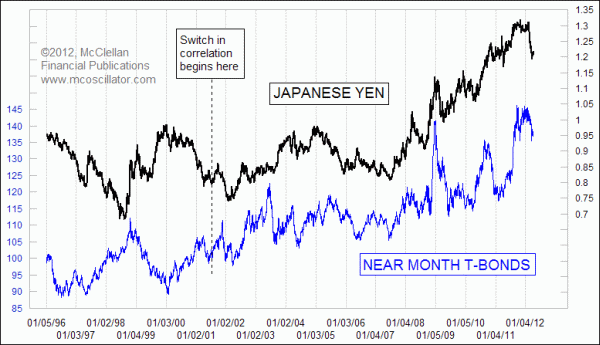
This week's chart makes the statement that T-Bond prices are headed higher, and it does so in a roundabout sort of way.  In the upper portion of the chart is the price plot of T-Bonds (continuous near month contract).  The lower plot shows an indicator derived from data in the CFTC's weekly Commitment Of Traders (COT) Report.  But rather than look at the data on T-Bonds themselves, which can sometimes give wishy-washy information, here we are looking at the commercial traders' net position in the Japanese yen.

Commercial traders are the "big money" traders who hold large positions.  How large is "large" differs among the various futures contracts, and the CFTC sets out the rules for those determinations.  Because the commercial traders are the big money, the presumption is that they are also the "smart money". 

Right now, commercial traders of Japanese yen futures are holding a really big net long position.  That means they think that the yen will go up in value versus the dollar, and so they have positioned themselves to profit from that expected move.

The whole reason why this is relevant for T-Bond prices is that there is a really strong positive correlation between T-Bond prices and the Japanese yen.  But this has not always been so.  The chart below shows that relationship, and you can see that before about mid-2001, it used to be an inverse relationship.  Somebody flipped a switch in 2001, and now it is a strong positive correlation.  

Japanese yen versus T-Bond prices

So because the yen does pretty much what T-Bond prices do, at least in terms of the direction of travel, we can make reasonable inferences about what lies ahead for bond prices by looking at what lies ahead for the yen.  When the commercial traders are holding their biggest net long position in Japanese yen futures in several years, the implication is pretty strong that the yen should head higher in the coming weeks.  And as the yen heads higher, T-Bonds ought to tag along, whether they deserve to go up or not.

Given what we have learned from another borrowed COT Report relationship, that positive period for T-Bonds is not likely to last beyond early June.  The inverse relationship between T-Bond price and stock prices is still working very well, so the opportunity for T-Bond prices to advance should only last as long as stocks are in a corrective mode, and that corrective mode is scheduled to be finished by early June. 


Article from Business Insider

Asia Stocks Slide as Europe Debt Crisis Concern Flares


By Yoshiaki Nohara - Apr 5, 2012 3:49 PM GMT+0800
Article from Bloomberg

Most Asian shares fell, with the regional benchmark index headed for its biggest two-day decline in a month, after Spain struggled to sell bonds, renewing concern Europe won’t be able to contain its debt crisis.

Hutchison Whampoa Ltd. (13) and other companies that do business in Europe slid after demand fell at a Spanish government bond auction, sparking concern about the region’s sovereign-debt crisis. Industrial & Commercial Bank of China Ltd. dropped 2 percent after Premier Wen Jiabao said China needs to break the “monopoly” of a few big lenders. Soho China Ltd. rose 2.5 percent, leading gains among mainland developers after Credit Agricole SA said China is “almost guaranteed” to ease monetary policy further this month.

The MSCI Asia Pacific Index dropped 0.1 percent to 125.33 as of 4:47 p.m. in Tokyo after losing as much as 1.2 percent. More than two shares fell for each that rose on the measure, which yesterday slid 1.5 percent, the most since Dec. 19, after the U.S. Federal Reserve signaled it may not offer more stimulus.

“Expectations for China’s additional easing are causing short-covering,” said Yutaka Miura, a senior technical analyst at Mizuho Securities Co. “It’s not that a real solution has been brought to Europe’s crisis. That’s why Spain’s debt sale is reviving concern.”

BOJ Nominee

The MSCI Asia Pacific Index has risen about 10 percent this year amid signs the U.S. economy is recovering. Gains slowed after China last month cut its target for economic growth as it seeks to cool the property market and become less dependent on exports.

Japan’s Nikkei 225 Stock Average pared a loss to 0.5 percent after the rejection of a Bank of Japan nominee came as a victory for lawmakers pressing for more monetary easing.

South Korea’s Kospi Index rose 0.5 percent after the government said foreign direct investment into the nation increased 17 percent in the first quarter. Australia’s S&P/ASX 200 fell 0.3 percent.

Hong Kong’s Hang Seng Index retreated 1.1 percent, with trading volume 6.9 percent below the 30-day average. Markets in the city were closed yesterday for a holiday and will also be shut tomorrow. India and the Philippines are having holidays today.

The Shanghai Composite Index, which tracks the bigger of China’s stock exchanges, rose 1.7 percent after the government said it will more than double the amount foreigners can invest in equities, bonds and bank deposits.

A measure of volatility on the Hang Seng index rose 7.9 percent to 19.99, indicating traders expect a swing of 5.7 percent on the gauge over the next 30 days. Readings for the Nikkei 225 and core stocks on South Korea’s benchmark dropped.

Spain Debt Sale

Futures on the Standard & Poor’s 500 Index (SPXL1) advanced 0.1 percent today. The gauge sank 1 percent in New York yesterday after a measure of conditions at U.S. service companies showed slowing growth.

In Europe, Spain struggled to borrow in financial markets yesterday, selling 2.6 billion euros ($3.4 billion) of bonds at an auction, an amount that was near the bottom of a range set by the Treasury for the sale. European Central Bank President Mario Draghi said the region’s economic outlook is “subject to downside risks.”

“Investors realize those economies are heading into a significant recession,” said Andrew Pease, Sydney-based chief investment strategist for the Asia-Pacific region at Russell Investment Group, which manages about $150 billion. “Gains from here are going to be hard work.”

Companies that do business in Europe slid. Hutchison Whampoa lost 1.9 percent to HK$76.20. Cosco Pacific Ltd. (1199), which operates container facilities at Greece’s Piraeus port, slid 1.9 percent to HK$11.36 in Hong Kong. Nissan Motor Co., a carmaker that gets almost a fifth of its revenue from Europe, lost 1 percent to 869 yen.

‘Almost Guaranteed’

Stocks in the Asian-Pacific index, which includes companies from emerging markets, are valued at 1.4 times book value, compared with 2.3 times for the S&P 500 and 1.4 times for the Stoxx 600, according to Bloomberg data. A number below 1 means companies can be bought for less than value of their assets.

Stocks pared losses amid speculation China may relax some of its measures aimed at damping inflation.

The country is “almost guaranteed” to either cut interest rates or reserve requirement ratios in April, Dariusz Kowalczyk, a Hong Kong-based strategist at Credit Agricole, said in a Bloomberg television interview yesterday. The strategist cited comments made by Premier Wen Jiabao on April 3 that he plans to release fine-tuning measures “soon.”

Easing Speculation

China also accelerated the opening of its capital markets by more than doubling the amount foreigners can invest in stocks, bonds and bank deposits. Offshore investors will also be allowed to pump an extra 50 billion yuan ($7.9 billion) of local currency into the country, up from 20 billion yuan, according to a statement on April 3.

Mainland developers gained in Hong Kong. Soho China rose 2.5 percent to HK$5.78, and China Overseas Land & Investment Ltd. advanced 0.9 percent to HK$15.98. Agile Property Holdings (3383) Ltd. rose 2 percent to HK$9.86.

In Seoul, NHN Corp., operator of South Korea’s largest Internet search engine, gained 8.1 percent to 274,000 won after Daewoo Securities Co. increased its share-price estimate to 340,000 won from 300,000 won, citing a stronger outlook for mobile-advertising sales and growing popularity of NHN’s messaging service.

To contact the reporter on this story: Yoshiaki Nohara in Tokyo at ynohara1@bloomberg.net
To contact the editor responsible for this story: Nick Gentle at ngentle2@bloomberg.net.

Article from Bloomberg